
Every second at the drive-thru and every wrong bag has a price. In the 2025 Intouch Insight & QSR Magazine Drive-Thru Study, the average total drive-thru visit took 5 minutes 35 seconds, and industry order accuracy slipped to 87% — down from 89% the year before. At the volumes a busy QSR runs, small movements in either number add up to real money.
The catch is that most operators can't see these numbers clearly. Timers get started late, accuracy is sampled by the occasional mystery shopper, and there's rarely a record of what actually happened at 12:15 on a Friday. Computer vision closes that gap: it watches the work continuously, measures it the same way every time, and keeps the evidence.
The two numbers that move a QSR
Speed of service
A camera can time the drive-thru far more precisely than a manual stopwatch or a single loop sensor. It sees each car arrive, sit at the menu board, pull to the window, and leave — so you get true per-station and per-car times, not one blended average. That's where the bottleneck hides: it's rarely the whole lane, it's one station at one daypart. Find it and you move the 5:35.
Order accuracy
Remakes and refunds are pure margin loss, and a wrong order costs a customer's next visit too. Computer vision can verify that what's assembled matches what was ordered — the right number of items, the right cups, the right modifiers — and flag a mismatch before the bag leaves the window. Instead of sampling accuracy once a month, you measure it on every order.
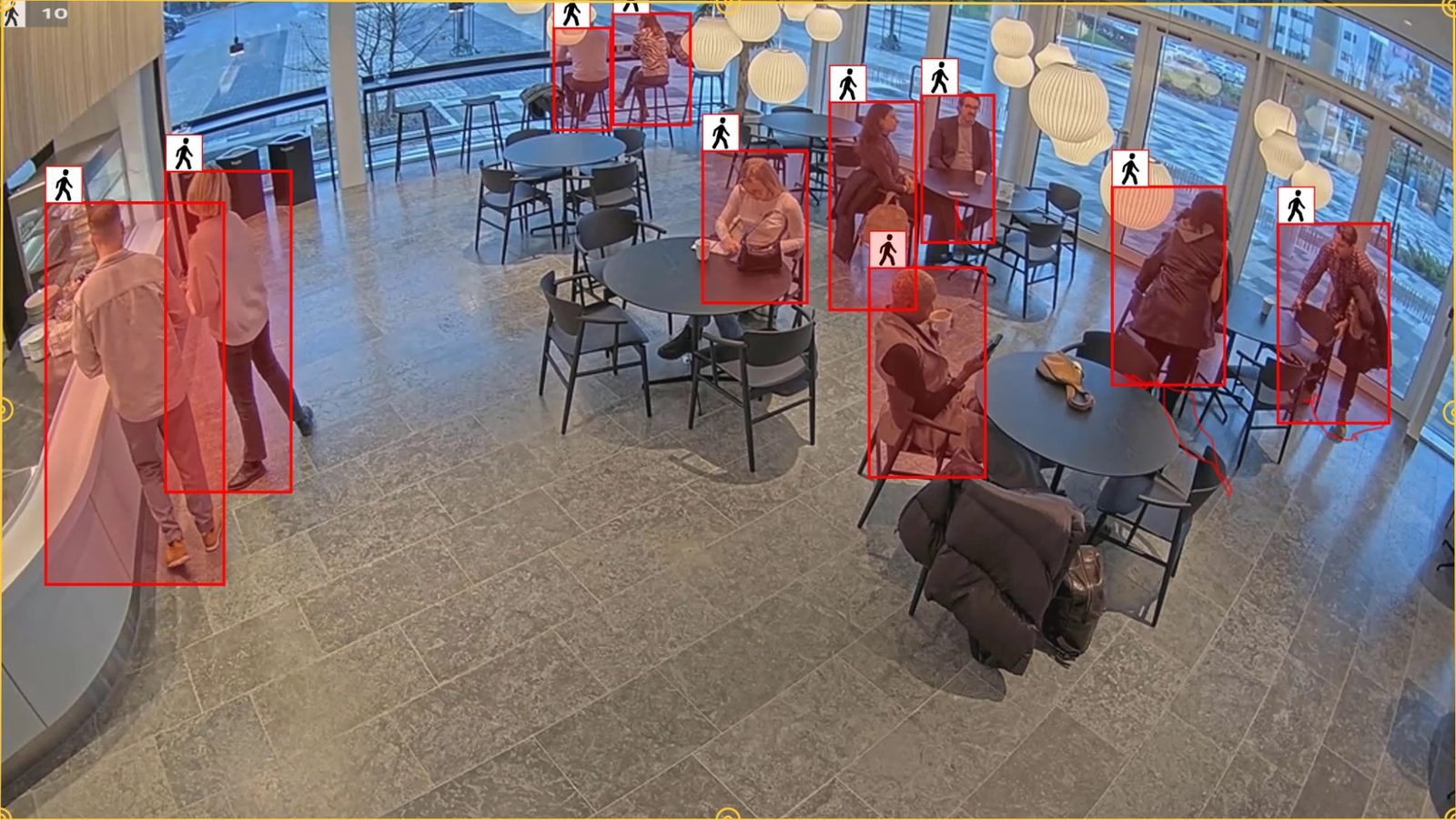
What computer vision actually does at a QSR
It's the same underlying capability — detect, track, and record — pointed at the moments that matter in a restaurant:
- Drive-thru timing: per-station and per-car service times, greeted-time, and pull-forward tracking.
- Order accuracy checks: does the assembled order match the ticket, before it leaves the window.
- Portion and prep consistency: catch over- and under-portioning that quietly inflates food cost.
- People counting and heat mapping: an accurate live count of who's in the lobby, queue or lot, and a map of where guests go, linger, and hesitate.
- Lobby queue and traffic analytics: queue length, dwell, and how traffic flows through the day.
- POS integration: tie what the cameras see to what the register rings — so traffic, dwell and drive-thru timing line up with real sales, and you can measure conversion, not just footfall.
- Upsell and peak-hour patterns: when the rushes hit and where the average ticket can grow.
- Hygiene and food-safety compliance: documented checks that protect your brand standards.
See how these map to the broader capability set on our computer vision solutions page, or the sector view on computer vision for QSRs.
The revenue and margin case
Speed and accuracy aren't just operational metrics — they're financial ones:
- Faster drive-thru moves more cars. Shaving seconds at the bottleneck station raises cars-per-hour at peak — and peak is where the revenue is.
- Fewer remakes and refunds protect margin. Every order that leaves right the first time saves food, labour, and a comped meal.
- Consistent portions cut food cost. Tightening portion variance is one of the most direct ways to protect a thin margin.
- Upsell and peak-hour insight grows the average ticket. Knowing exactly when and where demand spikes lets you staff and prompt for it.
From measurement to experience: audio, signage, and personalization
Once the cameras understand who's in the store and what they're doing, the same feed can shape the experience in real time — not just report on it after the shift. This is where a QSR moves from measuring the room to responding to it.
- Audio that reads the room. Adjust background music to the crowd and the daypart, and trigger a spoken promotion the moment someone pauses in front of a display or stands in an ordering area contemplating their choice — a nudge at exactly the second it can still change the order.
- Signage that responds. Digital menu boards and screens can react to what the cameras see — highlighting a combo when the queue is long, or a grab-and-go item when someone's clearly in a hurry.
- License-plate personalization at the drive-thru. With LPR, a returning car can be recognized as it pulls in, and the menu board can surface a tailored offer or a “your usual?” prompt based on that customer's previous orders — turning a generic board into a one-to-one pitch.
- Closed-loop with the POS. Tie these prompts back to the register and you can see which ones actually lifted the ticket, then keep the ones that work.
Done responsibly, this is about relevance, not surveillance. We design these systems to process on the edge, keep only the data the use case needs, and respect the privacy rules that apply at your locations — so the experience feels helpful, not creepy.
It runs on the cameras you already have
Most QSRs are already covered with cameras for security and coaching. Computer vision puts that existing estate to work, processed on the edge where bandwidth is tight, so you're adding insight rather than hardware. As an Axis Technology Partner, where new views are genuinely needed we specify only those — not a full rip-and-replace.
Honest note, and how to start
Tangent Solutions is a young practice. We build custom models trained on your restaurant, your cameras and your menu — not a generic detector — and we don't have a wall of QSR case studies to point at yet. What that buys you is our full attention, pilot-first pricing, and a founding-customer relationship with the person who writes the code. We'd rather tell you that up front than in the kick-off meeting.
The best way to get a real answer for your operation is a scoped pilot on one location: pick the number you most want to move — drive-thru time, accuracy, or food cost — and we'll show you what the cameras can measure before anyone commits to a rollout.
Sources: 2025 Drive-Thru Study, Intouch Insight & QSR Magazine (intouchinsight.com, qsrmagazine.com).